Health & Safety Policy — Office Clearance Knightsbridge
This Health and Safety Policy sets out the principles and arrangements for safe working during office clearance operations. It applies to all staff, contractors and any authorised personnel engaged in office clearance, rubbish removal and waste management activities under the banner of Office Clearance Knightsbridge and related service provisions. The policy emphasises prevention, risk control and continual improvement to protect health, safety and the environment.Policy scope and objectives
The scope includes planning and executing clearances in commercial premises, secure handling of refuse, transportation and disposal, and management of hazardous materials encountered during office clearance operations. Our objectives are to: reduce incidents, eliminate avoidable risks, ensure compliance with statutory obligations and promote a safety culture across the rubbish company service area. This policy does not replace statutory requirements but provides a framework for meeting them.
Responsibilities and management
Senior management retains overall responsibility for policy implementation, risk assessment and resource allocation. Supervisors and team leaders are responsible for day-to-day safety performance, ensuring staff receive appropriate training, equipment and support. Employees must follow safe systems of work and report hazards promptly. Contractors engaged for clearance work will be required to demonstrate competence and adhere to our standards.Risk assessments are carried out for each project and updated if circumstances change. Assessments consider manual handling, waste segregation, sharps, potential asbestos-containing materials, electrical hazards, fire risks and vehicle movements. Control measures follow the hierarchy of risk control: elimination, substitution, engineering controls, organisational measures and, where necessary, personal protective equipment (PPE).
Training and competence are essential. All operatives receive induction training covering manual handling techniques, correct use of lifting aids, PPE, safe use of tools and machinery, and emergency procedures. Refresher sessions, toolbox talks and scenario-based briefings are provided regularly to reinforce safe practices for rubbish clearance and office waste removal tasks.
 Safe systems of work require documented method statements for complex or high-risk clearances. These statements set out task steps, required controls, permitted personnel and emergency contacts. Permit-to-work systems are used where there are confined spaces, hot works or elevated risks. Supervisors must ensure method statements are available and understood by all involved parties before work starts.
Personal protective equipment is supplied and maintained; its use is mandatory where identified by risk assessment. Typical PPE includes gloves suitable for waste handling, high-visibility clothing, respiratory protection for dusty tasks, eye protection and steel-toe footwear. PPE is not a substitute for primary controls but a necessary layer of protection during clearance operations.
Manual handling controls focus on minimising manual lifts, using trolleys, sack trucks and mechanical aids, and team lifts for bulky items. Workers are trained in safe posture, load assessment and planning lifts to avoid overexertion. Incident data is monitored to adapt handling procedures and reduce musculoskeletal injuries linked to office clearance work.
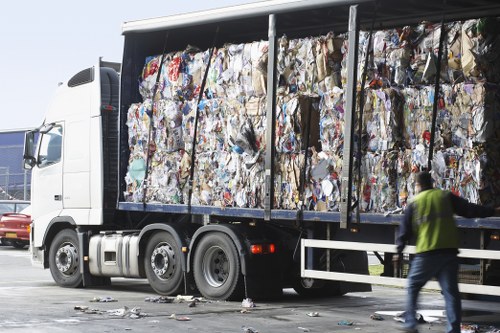
Waste segregation and disposal procedures are enforced to separate recyclables, general waste and hazardous items such as batteries or electronic components. Where hazardous materials are suspected, operations stop and competent advice is sought. Vehicles carrying waste are loaded and secured following transportation best practice to prevent shifting and spillage during transit.
Vehicle and traffic management is a key element for rubbish removal services. Loading areas are planned to minimise interactions with the public. Drivers receive training on safe loading, securing loads and vehicle checks. Delivery and collection schedules are managed to reduce congestion and ensure safety during drop-off and collection.
Incident reporting and investigation procedures are established to ensure timely reporting, recording and root-cause analysis of accidents, near misses and hazardous occurrences. Learning from incidents leads to corrective actions and updates to risk assessments and training. First aid provisions and emergency arrangements are maintained to assist any injured personnel.
 Monitoring, audits and review processes ensure the policy remains effective. Regular site inspections, internal audits and performance reviews are conducted. Compliance with this policy is subject to periodic management review and independent checks to ensure continuous improvement across our clearance operations and wider rubbish company service area.
 Communication and worker involvement are promoted through briefings, consultation forums and safety committees. Staff are encouraged to contribute to safety improvements, raise concerns and suggest practical changes. Open communication supports a positive safety culture and helps embed safe behaviours in every office clearance activity.
Legal compliance and standards adherence form the baseline of this policy. The organisation will maintain records demonstrating competence, training, risk assessments and waste transfer documentation where required. Contractual arrangements with third parties include provisions to ensure consistent safety outcomes across all contracted clearance work.
Policy review
This policy will be reviewed at least annually and after significant incidents, changes in legislation or operational changes. The aim is to align safety performance with best practice for office clearance, rubbish removal and waste management, ensuring staff, contractors and the public remain protected. All personnel are required to familiarise themselves with this policy and support its full implementation.
